
The Roman Onager: Rome's One-Armed Stone-Thrower
Roman OnagerOnagerRoman CatapultRoman ArtilleryTorsion CatapultAmmianus Marcellinus
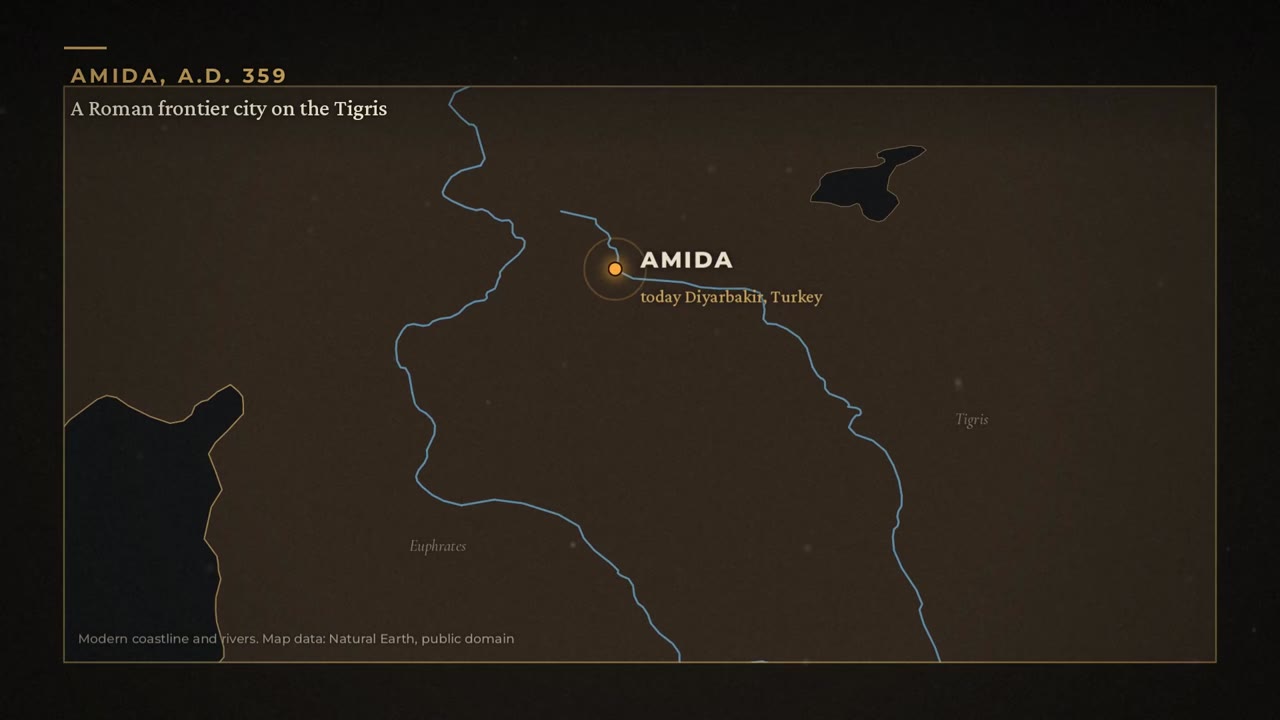
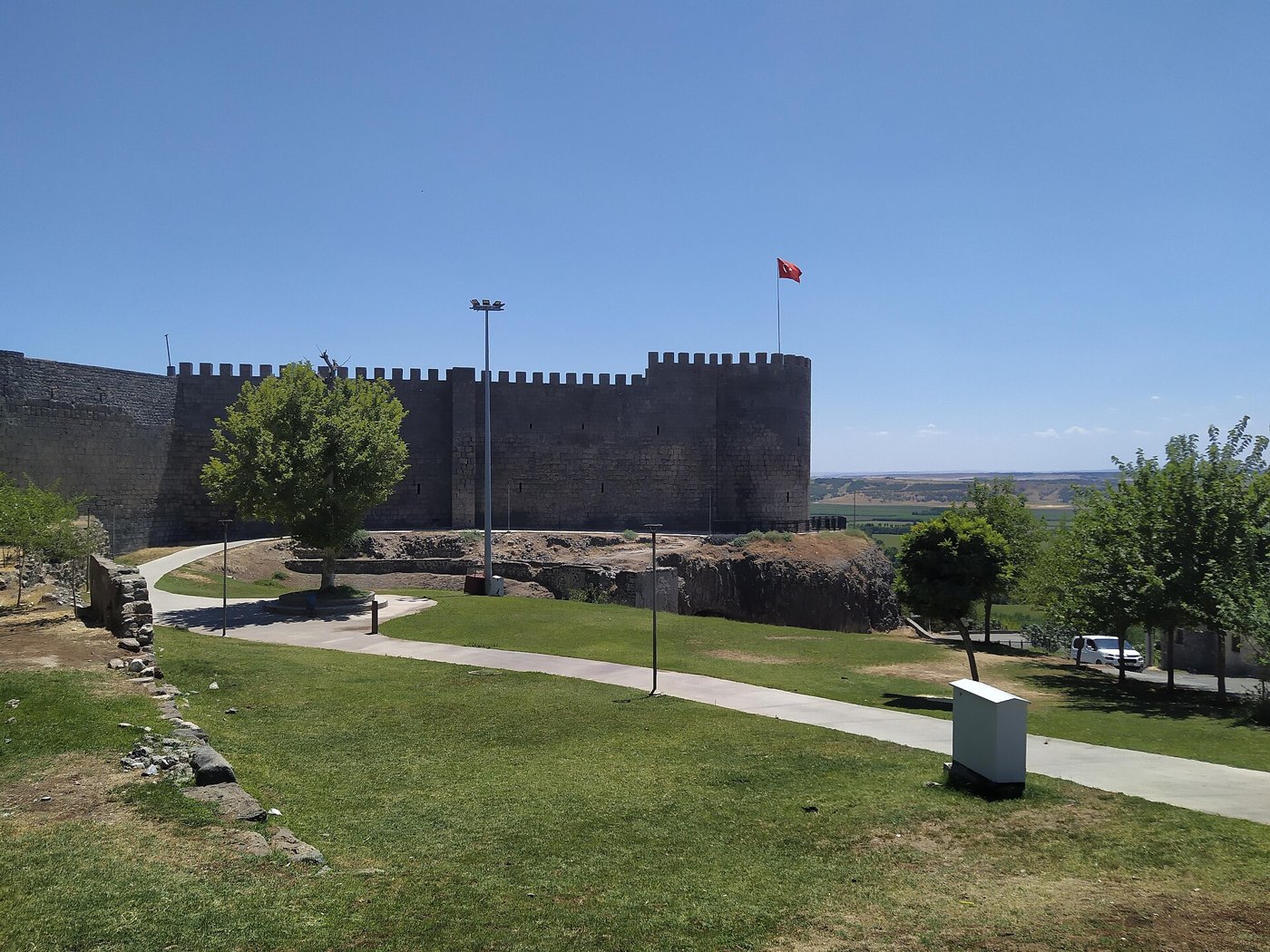
Amida. A Roman frontier city on the river Tigris. A.D. 359. The Persian king, Shapur, has surrounded it. And he has brought siege towers. Tall towers, faced with iron, rolled up to the walls. And on the top of each, a bolt-thrower, firing down onto the men on the ramparts.
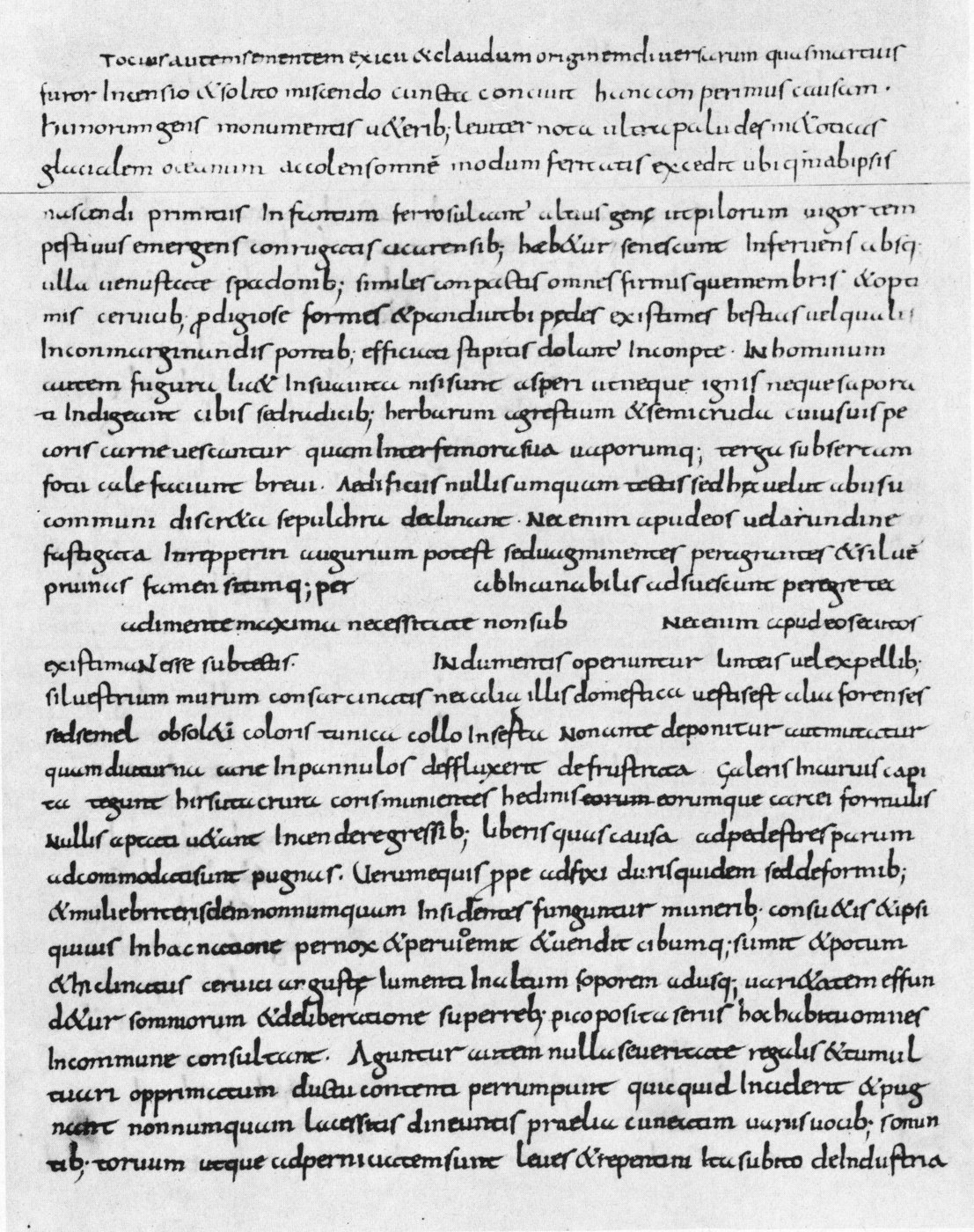
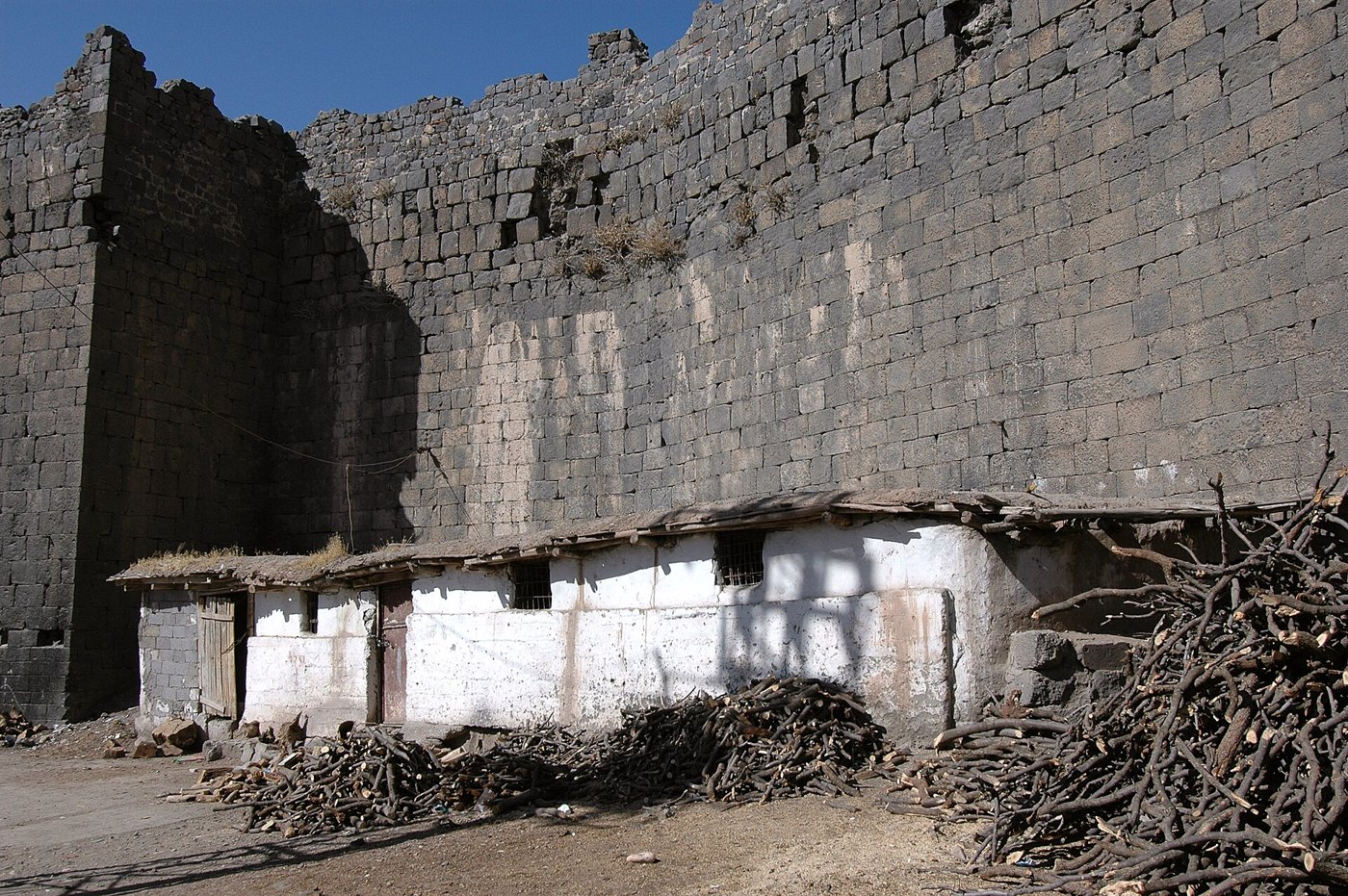
The defenders are being cut to pieces. One of them is a Roman officer named Ammianus Marcellinus. And he tells us that night fell while the Romans tried to work out what could answer this. The answer: scorpions. Machines that hurl round stones, from slings of iron. Moving them into place, he says, was a very difficult art.
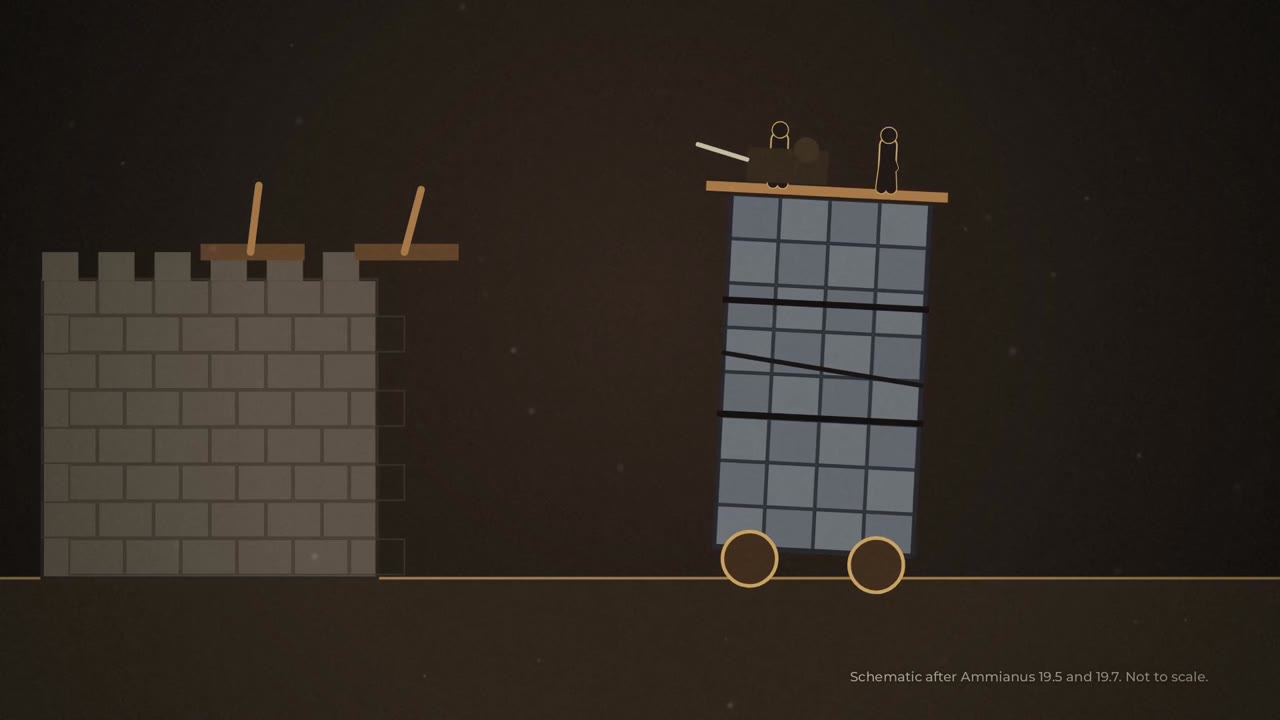
At dawn, the Persian army comes forward. With elephants. And the stones begin to fly. They loosen the joints of the towers. The bolt-throwers, and the men working them, are flung headlong. Some die without a wound, Ammianus writes. Others are crushed by the weight.
What is a Roman onager?
This is the Roman onager. One arm. One great spring of twisted rope. A sling. And a kick that, Ammianus says, could shatter a stone wall beneath it. Today we're taking it apart. How it worked. How it was crewed and carried. What it really did, at Amida and elsewhere. And what nobody knows. Because there is a lot nobody knows. As far as we can tell, no original machine has been found. The one real technical description is a few sentences, by one man.
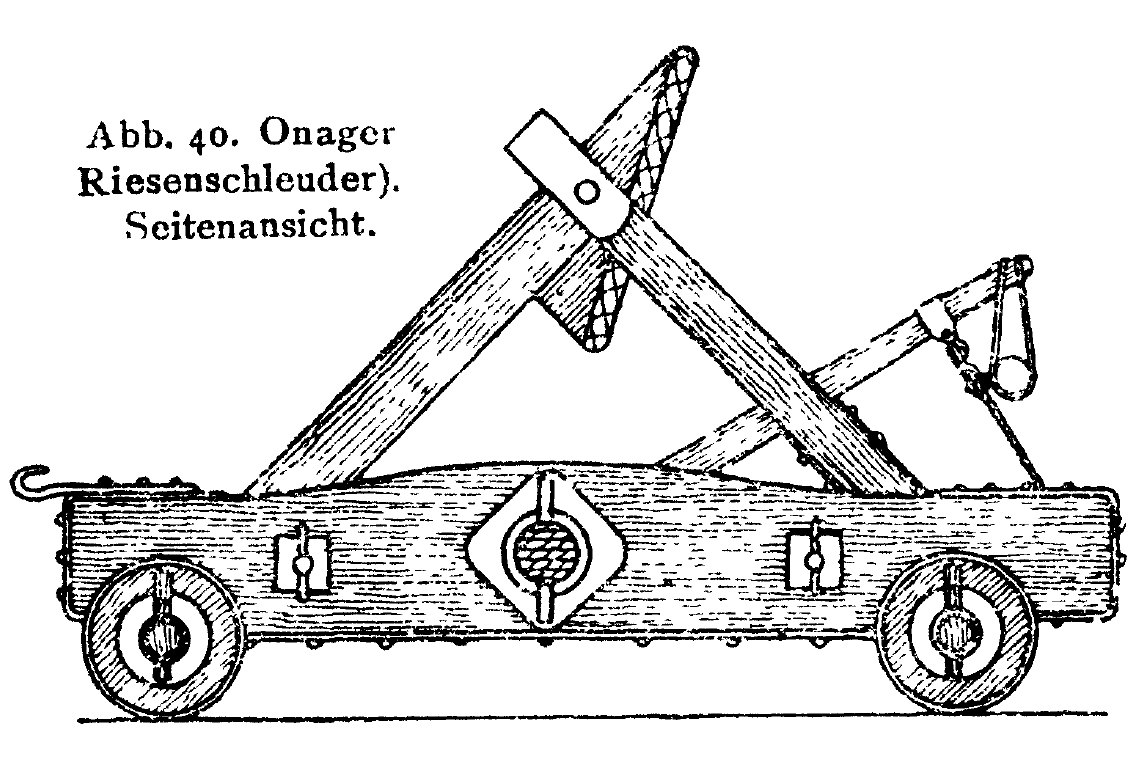
Every picture of an onager on this page, ours included, is a modern reconstruction. No original has been identified.
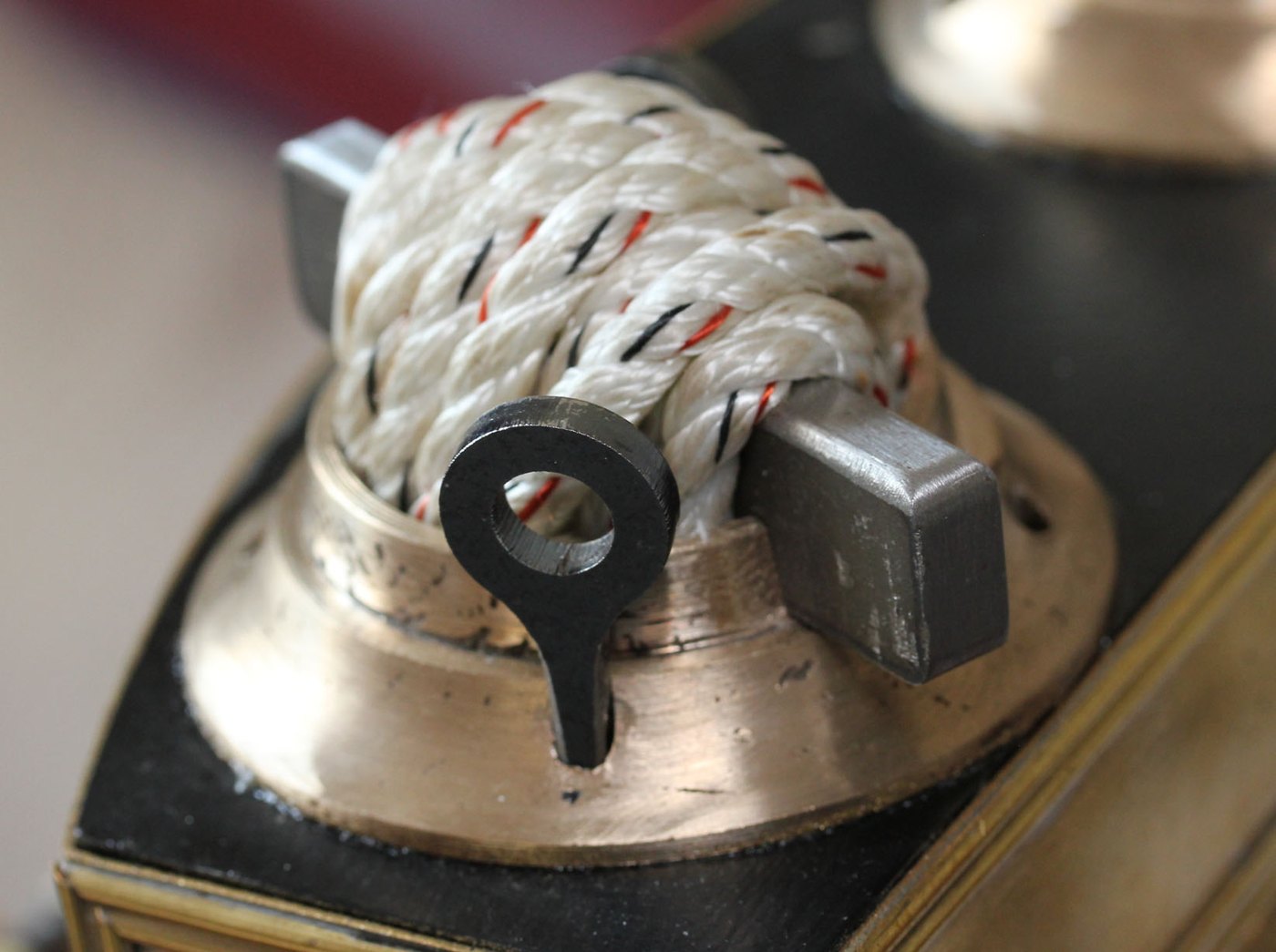
If you've seen our scorpion video, you already know the trick: twisted cord as a spring. The scorpion had two bundles of it. The onager has just one.
A name that kept changing
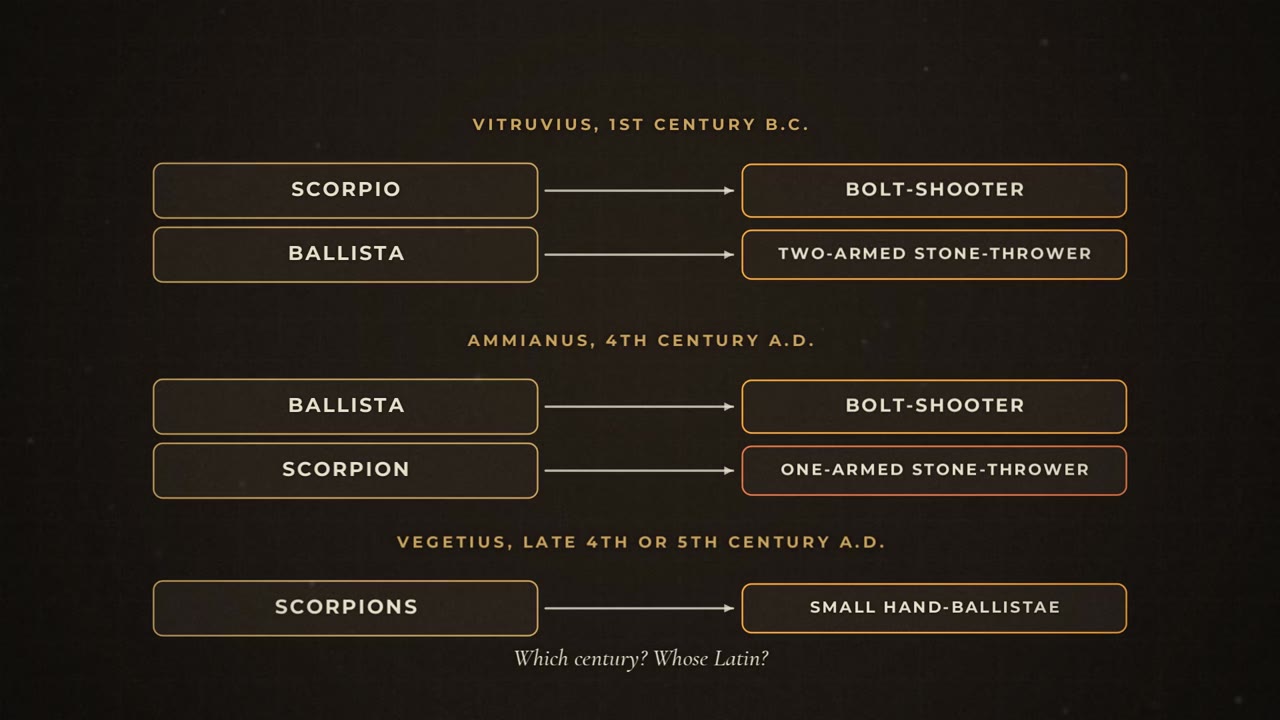
But first, a puzzle. The names. In the first century B.C., the engineer Vitruvius uses scorpion for a small bolt-shooter, and ballista for a machine that throws stones, with two arms. Four centuries later, Ammianus has swapped them. For him, a ballista is the bolt-shooter. And the scorpion is the one-armed stone-thrower, which, he says, is now called the onager. And Vegetius, another late writer, says that scorpions were what soldiers now call hand-ballistas. Small ones. So when a Roman writer says scorpion, you have to ask: which century, and whose Latin?
How old is the one-armed machine?
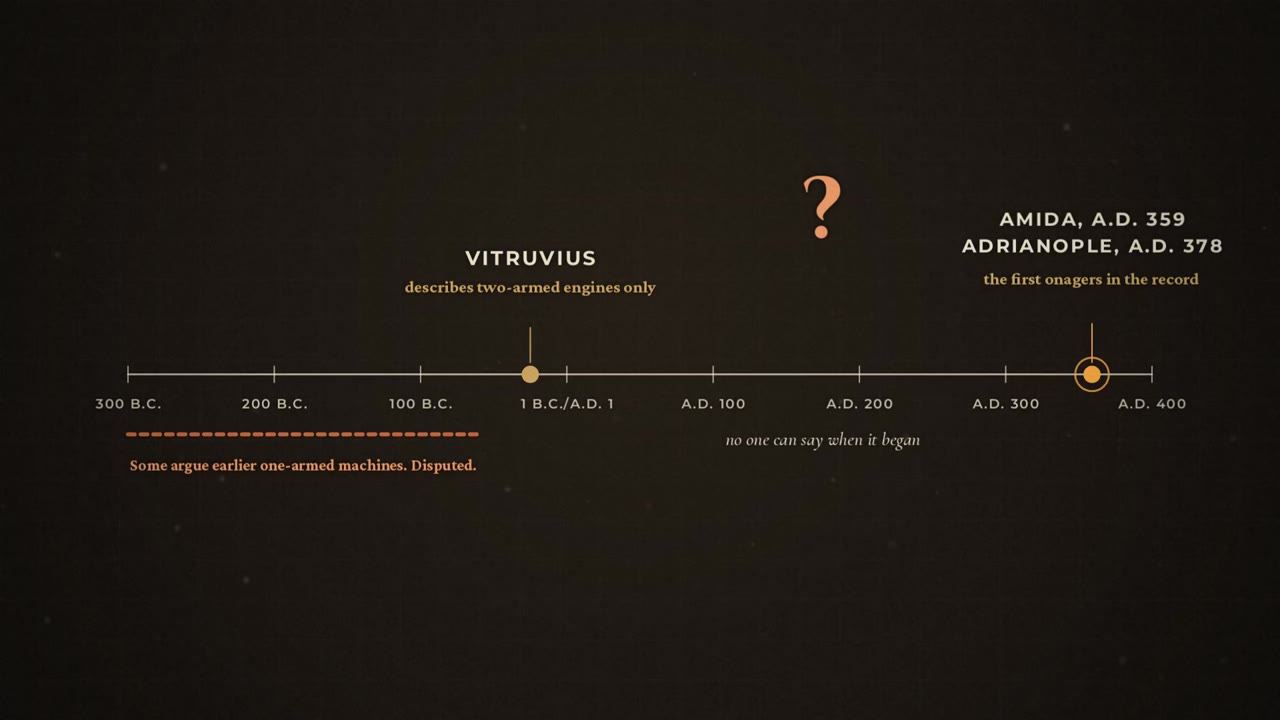
Was the one-armed machine new? Nobody knows. Ammianus says the name onager was given by a newer age. In another passage, that it's what common speech calls it. Some historians argue that one-armed stone-throwers existed in the Greek world centuries earlier. Another scholar, Duncan Campbell, says that argument might as well have been drawn from a conjuror's hat. One thing is obvious. One arm is simpler. One spring to build, and no second spring to tune like a lyre. And by Amida, on Ammianus's account, the Romans had it.
Why a wild ass?
Now, the name. Ammianus gives three, and explains each. Tormentum, because it works by twisting. Scorpion, because it has a sting standing up on top. And onager. The wild ass. Wild asses, he says, when hunters chase them, kick stones backwards so far that they pierce their pursuers' chests, or burst their skulls. That's his explanation of the name. Whether real wild asses kick like that is another matter. The animal itself is real. The Persian onager, a wild ass that still lives in Iran.

Did you know? Ammianus explains the name onager, wild ass, with a story: when hunters chase wild asses, he says, the animals kick stones backwards so hard that they pierce the hunters' chests or burst their skulls. Whether real wild asses kick like that is another matter.
Taking it apart, from Ammianus
So what did it look like? Ammianus is our only guide. A frame of two timbers, oak or holm oak, slightly curved, joined like the frame of a saw. Between them, strong ropes are threaded through holes and bound tight, so that the frame can't burst apart. From the middle of those ropes rises the arm, slanting up like the pole of a wagon, woven into the cords so it can be pulled down, and let go. At its tip, iron hooks, and a sling of hemp, or of iron. And beneath it, a huge cushion. A hair-cloth sack stuffed with chaff, lashed down, on a mound of turf or bricks.
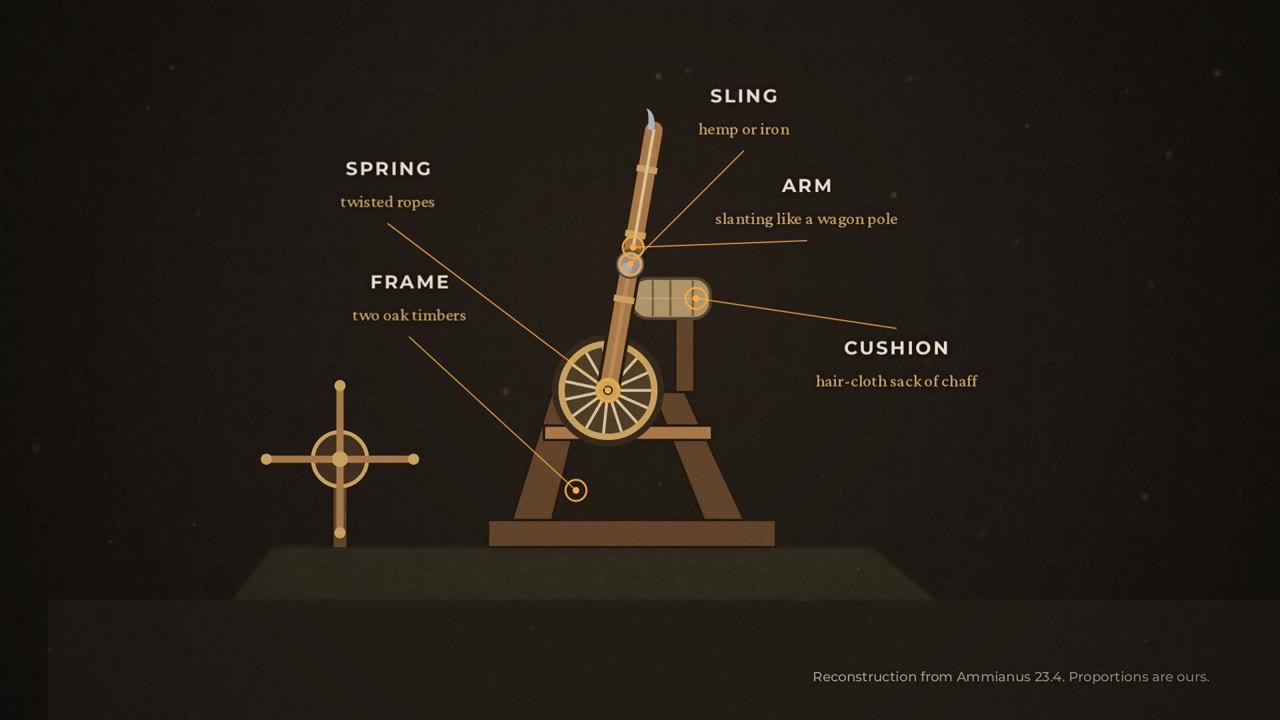
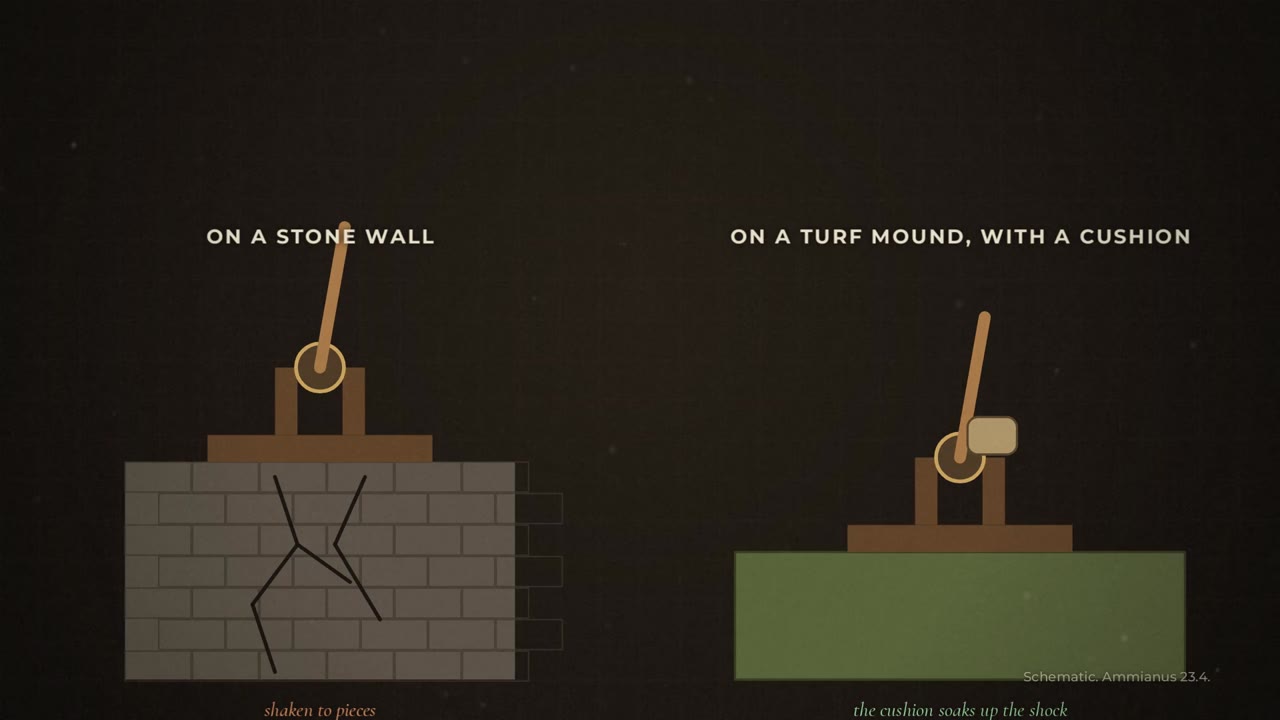
Not on a stone wall. Such a mass, he says, would shake whatever lay beneath it to pieces, by violent shock, not by its weight. Hold on to that, because at Amida they fired from the ramparts. Somehow, the crews found a way.
Firing it
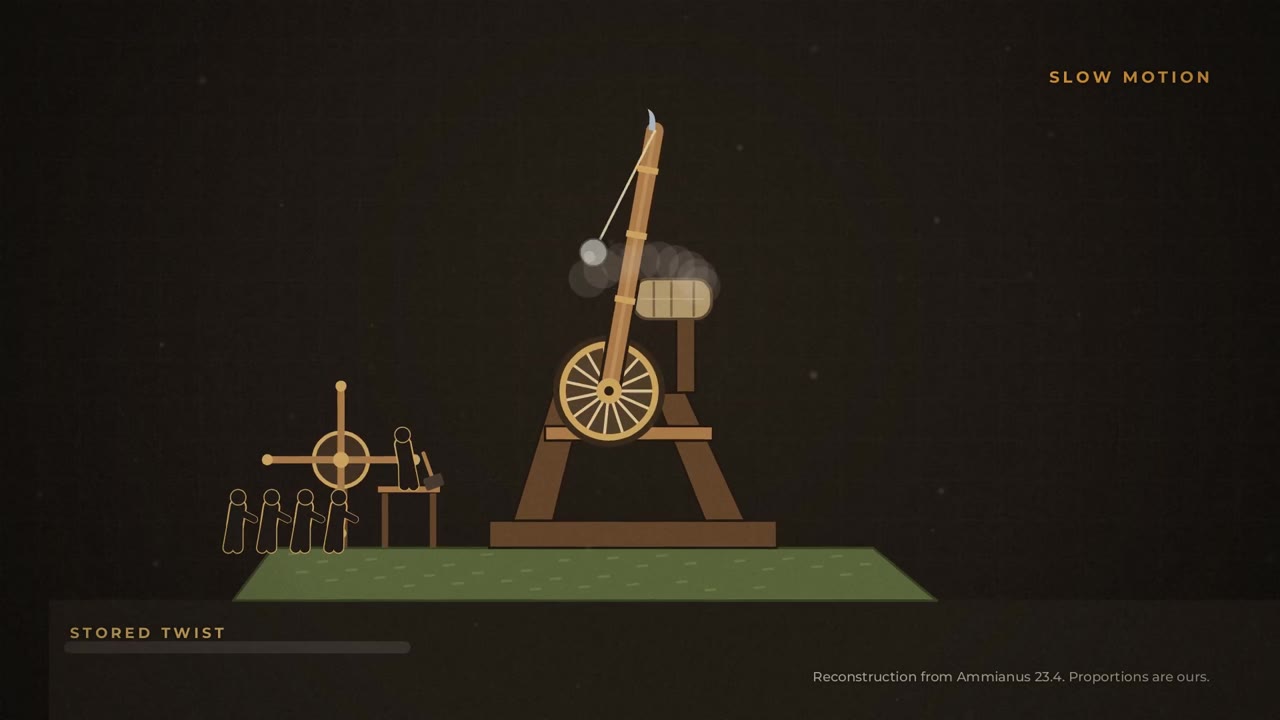
Now, to fire it. A round stone goes into the sling. Four young men on each side work the bars, hauling the arm back until it's almost lying flat. Then the master, standing up high, strikes the catch with a heavy mallet. The arm whips up. It slams into the cushion. And the stone goes flying.
Why the sling works
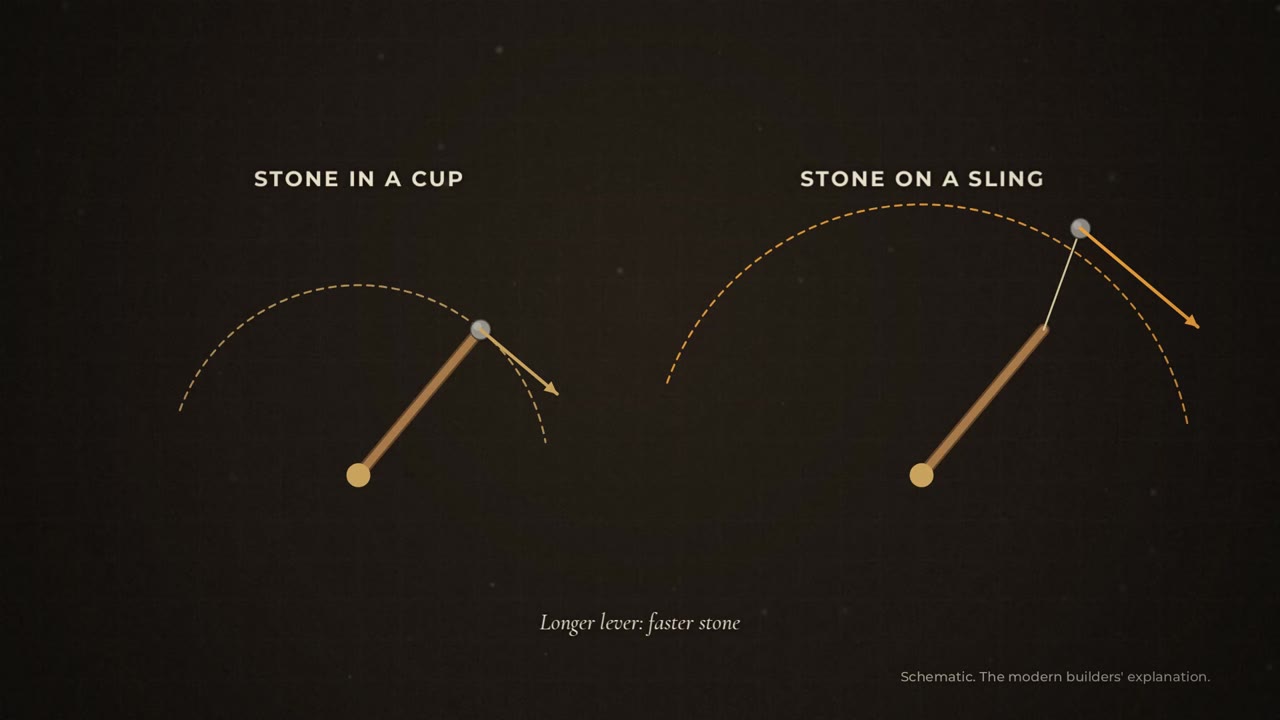
Why a sling? Because it makes the arm longer, without making it heavier. The cushion stops the arm dead. The stone isn't stopped. It keeps going, and the sling lets it go. That, at least, is how modern builders explain it. Ammianus just says the arm hit the cushion, and the stone flew. And building one is hard. At Butser Ancient Farm, in Hampshire, students found that the rope bundle slipped, and the arm was very hard to wind back. They added locking pins to hold the twist, and a ratchet to crank the arm down. Ammianus mentions neither.
Ten to a legion
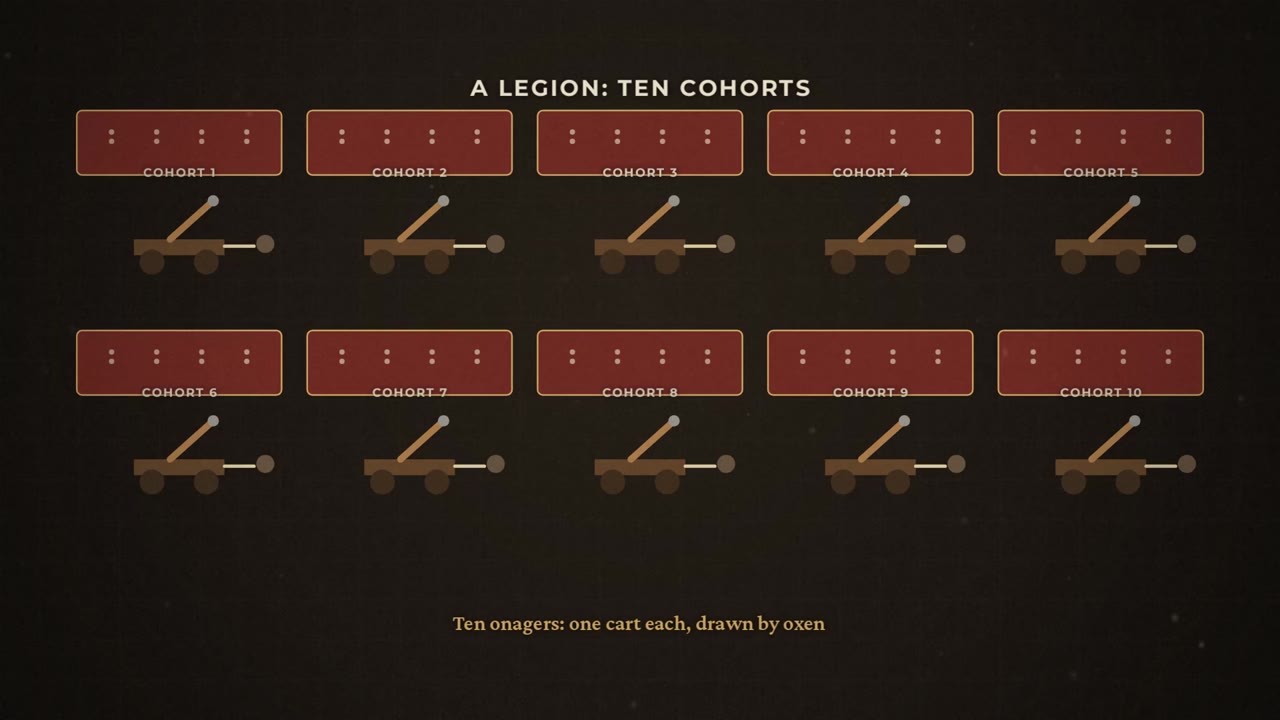
Now picture an army on the march. Vegetius says every legion had ten onagers. One for each cohort. They travelled on carts pulled by oxen, ready for use, so that if an enemy attacked the rampart of a camp, it could be defended with arrows, and with stones. This is the same Vegetius who gave us fifty-five bolt-shooters in the scorpion video. He's a late writer, describing an older, idealised army, and his numbers are tidy. Perhaps too tidy. And like the scorpion, the onager ran on sinew. Without cords of sinew, he says, onagers and ballistae are useless. Horses' tail and mane hair is kept in store as well. And women's hair, he insists, is just as strong.
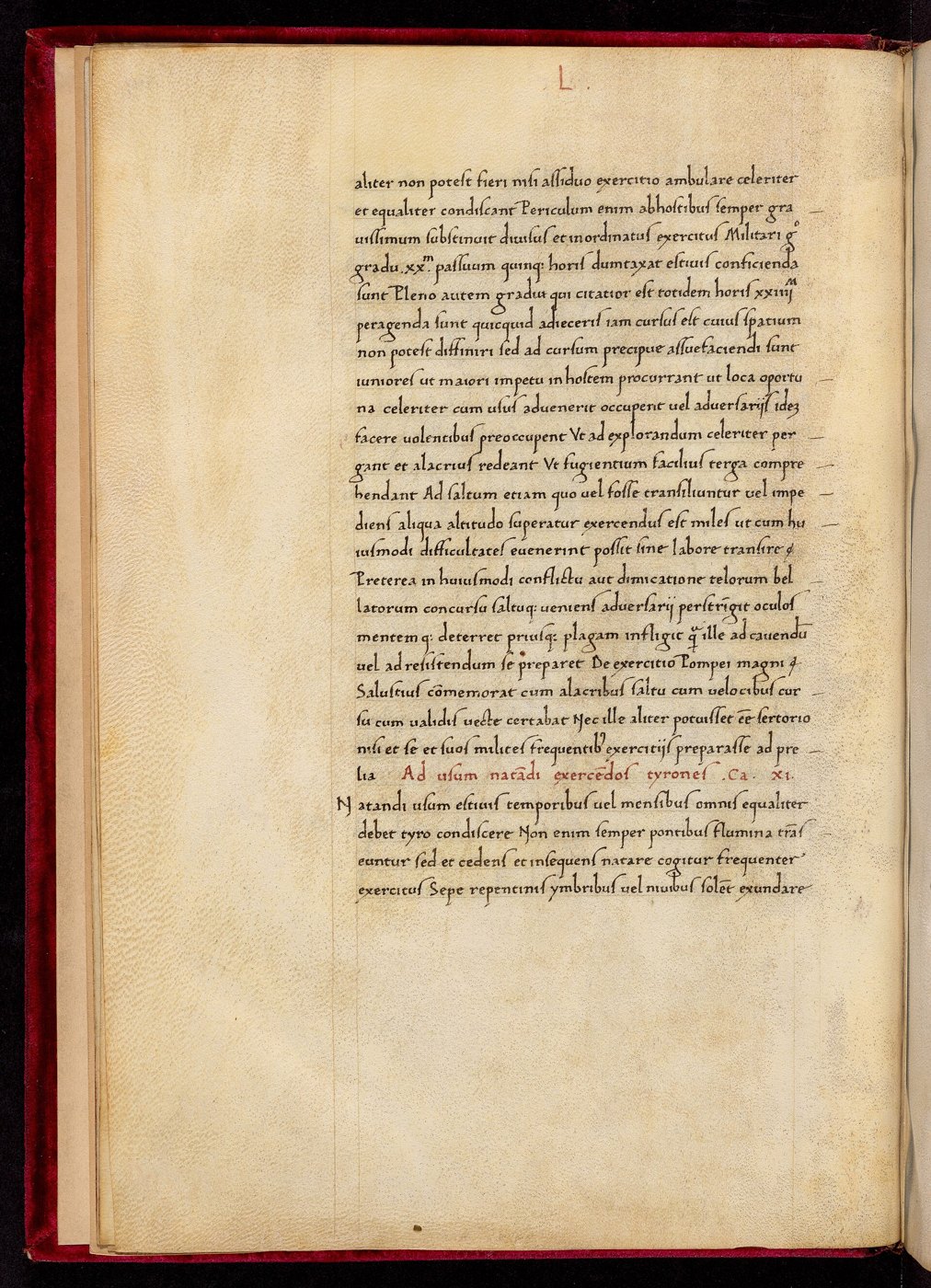
Did you know? A Roman torsion machine ran on hair as well as sinew. Vegetius says horses' tail and mane hair was kept in store, and he insists that women's hair is just as strong.
What it was for
So what was it for? Vegetius, writing about the defence of a city, lists it among the best weapons for the walls. Heavy stones thrown by the onager, he says, crush horses and men, and smash the enemy's machines. That's exactly what Ammianus saw at Amida. Towers shaken apart, and their machines with them.
Adrianople, A.D. 378
But the onager could do something else. It could frighten. Adrianople, A.D. 378. The Roman emperor Valens has just been killed, and his army destroyed, by the Goths. The Goths turn on the city itself, where the emperor's treasure is thought to be. And in the fighting at the walls, Ammianus tells us, a scorpion, the kind that common speech calls an onager, is set up facing the Goths' dense line. It hurls one huge stone. The stone hits the ground, and seems to do nothing at all. But the Goths, stunned by the sight of something new, start to pull back from the middle of their line. Then the horns of their leaders sound, and the fight goes on.
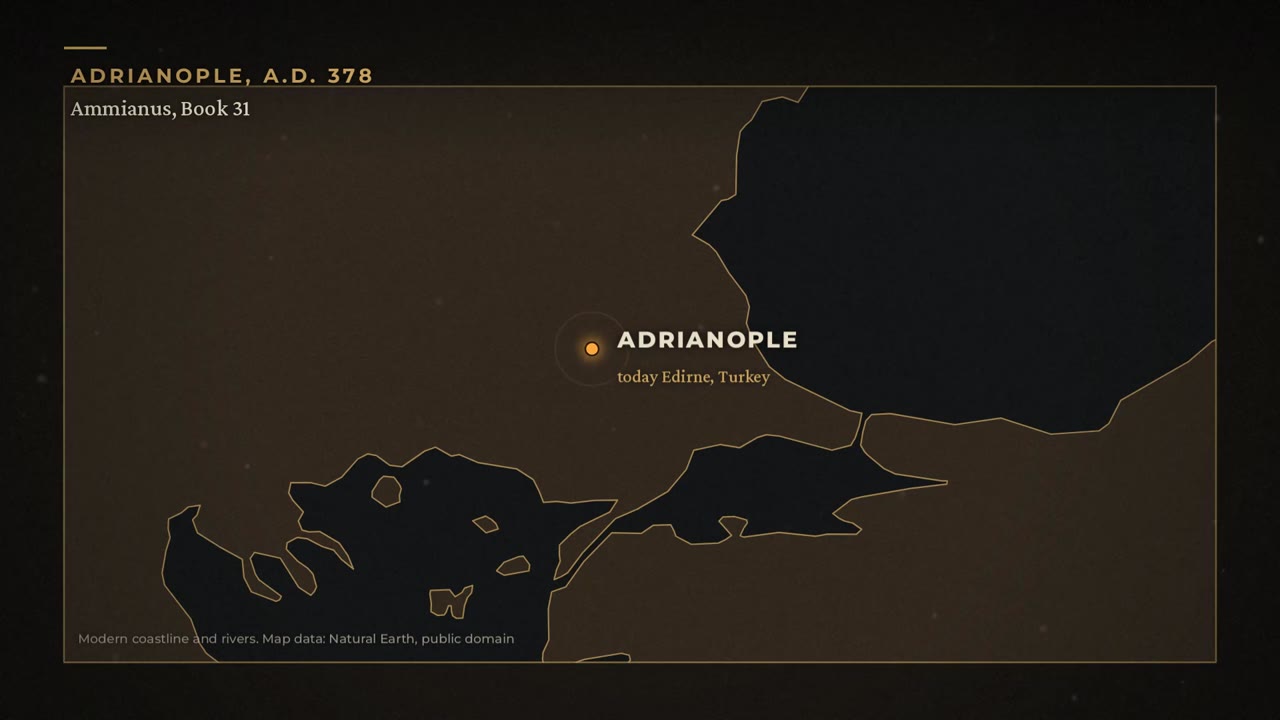
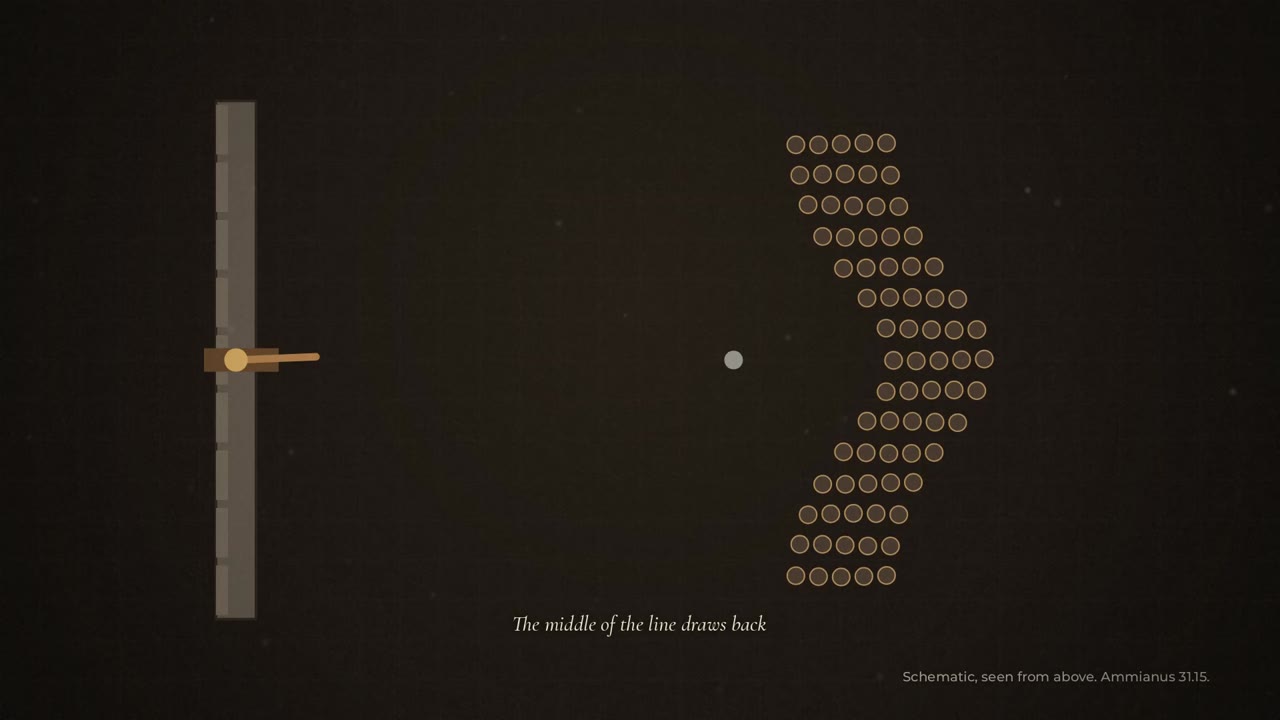
Did you know? At Adrianople in A.D. 378, Ammianus says, one stone from a scorpion, the kind common speech calls an onager, hit the ground and seemed to do nothing at all. The sight of something new was enough to make the Goths start pulling back from the middle of their line.
The engineer who stood behind it
The machine was dangerous to its own side too. Julian's invasion of Persia, A.D. 363. At the siege of Maiozamalcha, Ammianus watches an engineer, whose name he doesn't recall, standing behind a scorpion. A stone that one of the crew had fitted unsteadily into the sling flies backwards. It crushes the engineer's chest, and he is killed. The body, Ammianus says, was so torn apart that no part of it could be recognised. Behind the machine, it turns out, was no place to stand.
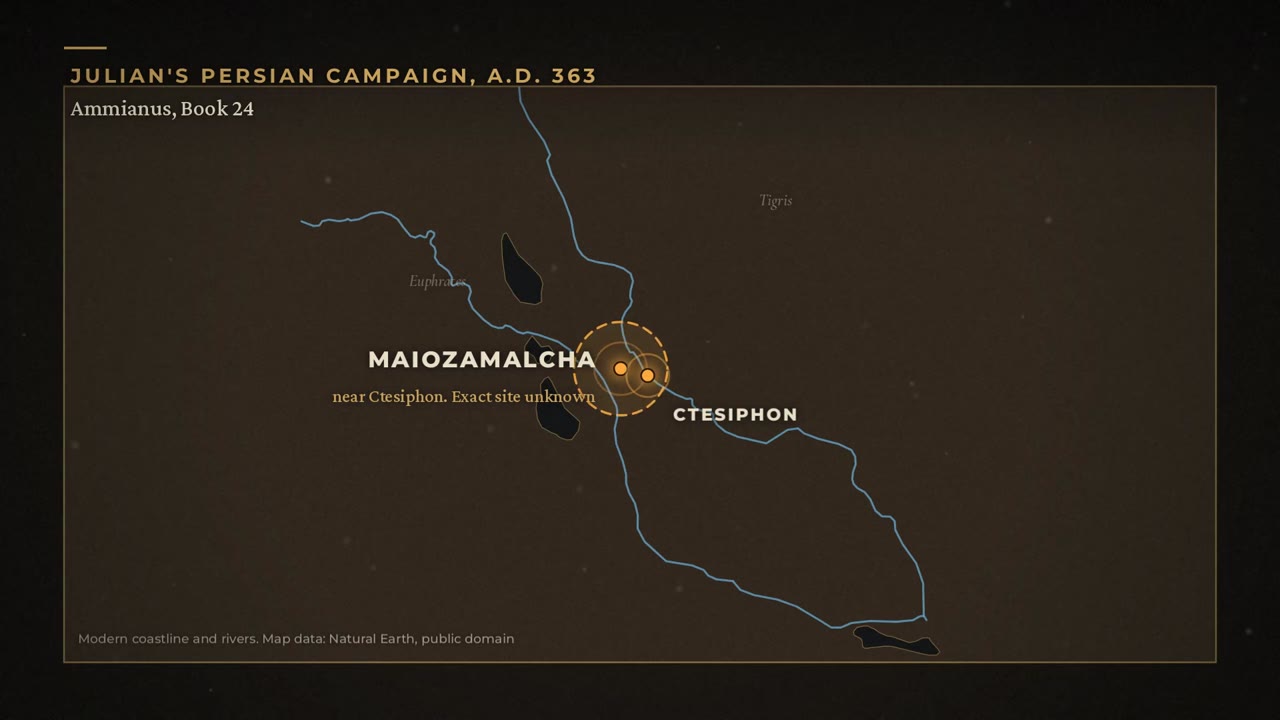
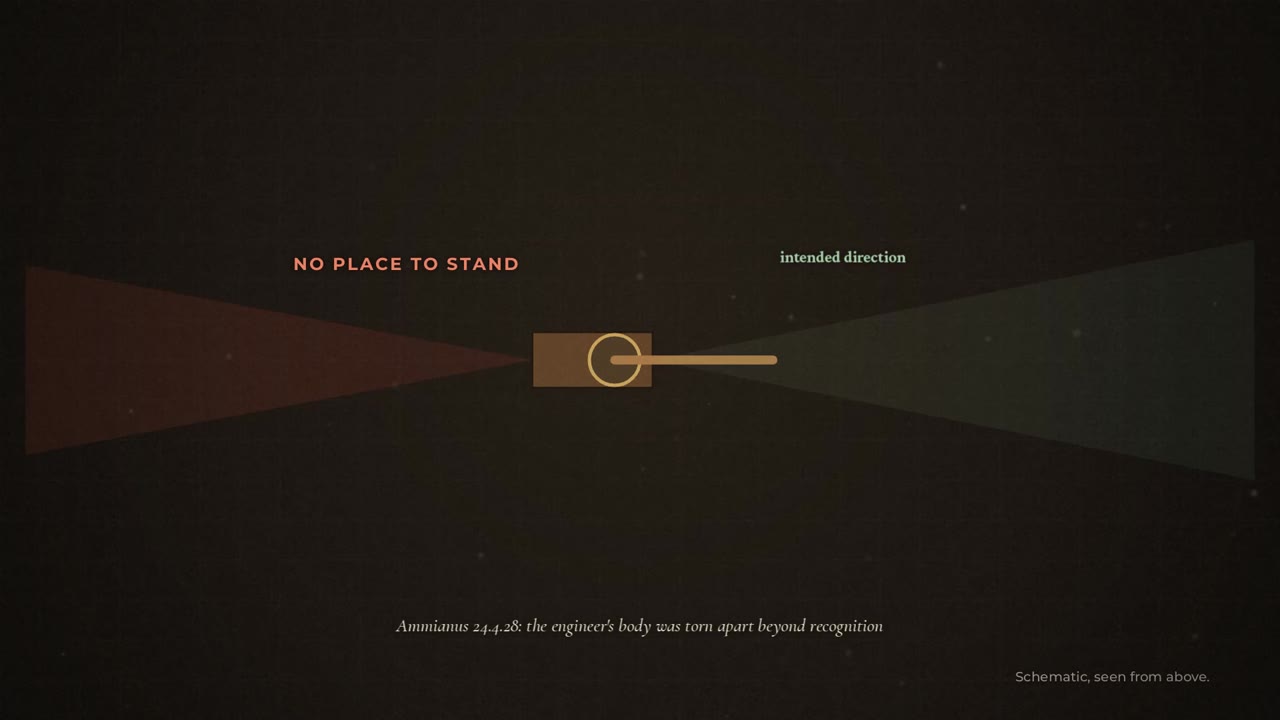
Did you know? The engineer killed at Maiozamalcha has no name in our source. Ammianus says he does not recall it, and that the body was so torn apart that no part of it could be recognised.
Three myths
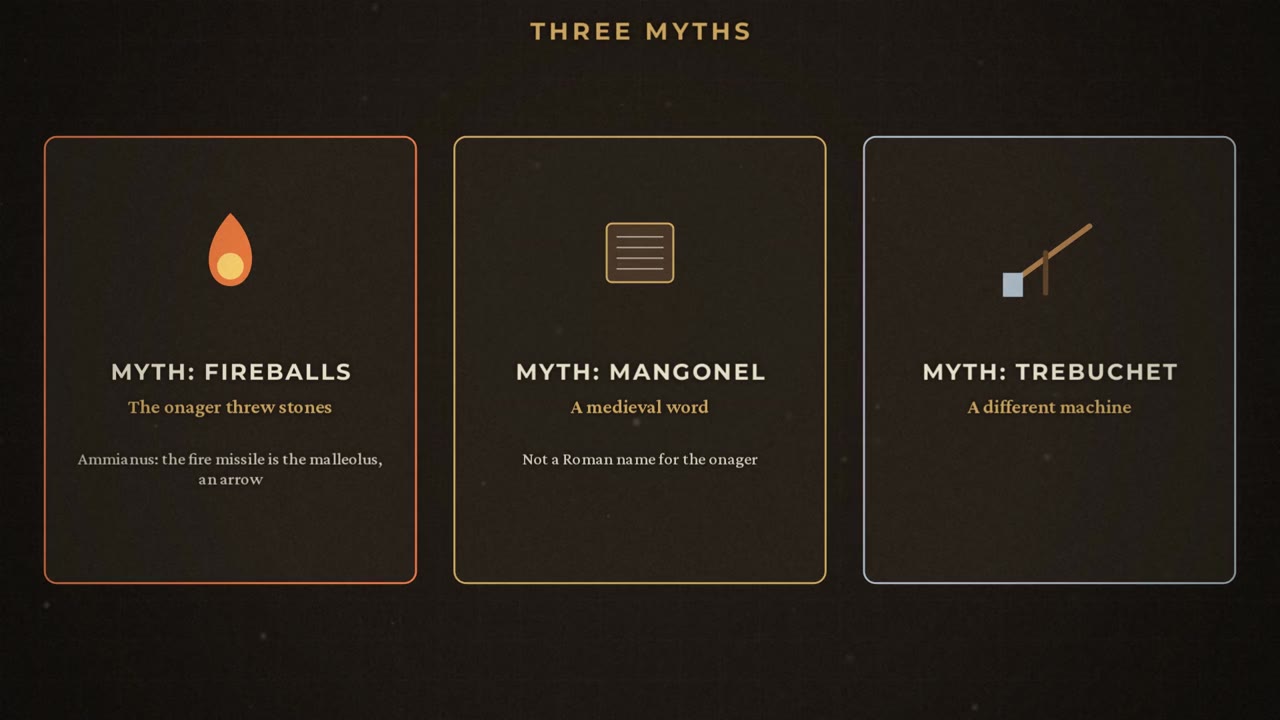
Now, the myths. The first: fireballs. In films, the catapult always throws fire. In the Roman sources, the onager throws stones. The only fire missile Ammianus describes in that chapter is the malleolus. A reed arrow with an iron head, hollowed out and packed with fire. Shot from a weak bow, because a fast shot would put the fire out. The second: the word mangonel. It's a medieval word. And the historian Peter Purton has argued that the idea of Roman torsion machines carrying on through the Middle Ages is largely a myth. The third: the trebuchet. A different machine, powered by a falling weight, not by twisted rope.
What we really have
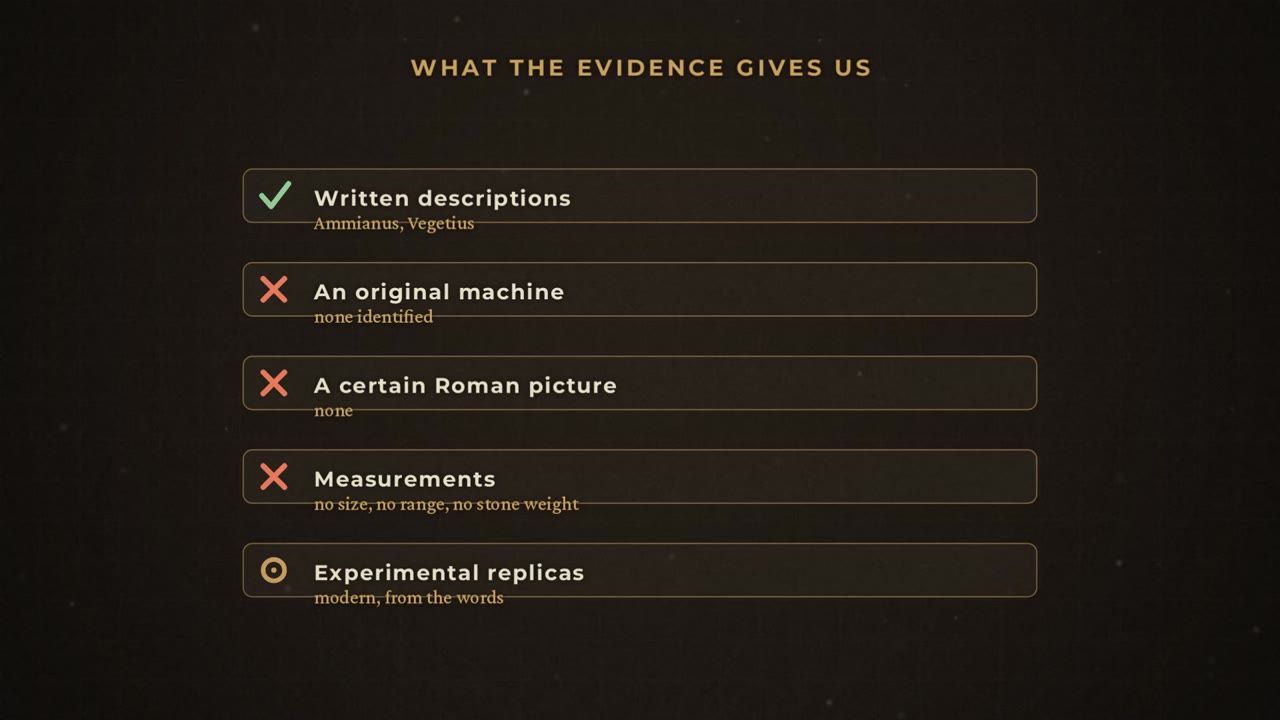
So what do we actually have? Words. Ammianus. Vegetius. A few battles, and an accident. What we don't have is a machine. As far as we know, no original has been found, and no Roman picture of one is certain. No measurements, either. Ammianus gives no size, no range, and no weight for the stone. So every onager you have ever seen drawn, built, or fired is a reconstruction. Including ours.
Verdict, and what comes next
So that's the Roman onager. A late machine, known from a few sentences. One arm, one spring, one sling, one cushion. It shook towers apart at Amida. It frightened Goths at Adrianople. And it killed one of its own engineers. Not a sniper's tool, like the scorpion. A weapon for breaking things. Next up is something much smaller. A piece of iron with four spikes, one always pointing up. The caltrop.
Over to you
Would you have stood beside this machine on the wall at Amida? What next after the caltrop: the gladius or the lead sling bullet?
Prefer to watch? The video on YouTube covers the same story with the full animations. Jump to a part:
- 0:00 The towers of Amida, A.D. 359
- 1:15 What is a Roman onager?
- 2:04 A name that kept changing
- 2:43 How old is the one-armed machine?
- 3:20 Why a wild ass?
- 3:59 Taking it apart, from Ammianus
- 4:56 Firing it
- 5:23 Why the sling works
- 6:02 Ten to a legion
- 6:51 What it was for
- 7:13 Adrianople, A.D. 378
- 7:59 The engineer who stood behind it
- 8:34 Three myths
- 9:21 What we really have
- 9:53 Verdict, and what comes next
Quick answers
What was the Roman onager?
A one-armed Roman stone-throwing machine powered by twisted rope. Ammianus Marcellinus, who was at the siege of Amida in A.D. 359, describes one arm held in a spring of twisted cords, a sling at its tip, and a cushion that stops the arm so the stone flies on. No original machine has been found.
Why was it called an onager?
Onager means wild ass. Ammianus explains the name by saying that wild asses, chased by hunters, kick stones backwards so hard that they pierce the hunters' chests or burst their skulls. Whether real wild asses kick like that is another matter.
How many onagers did a Roman legion have?
Vegetius says every legion had ten, one for each cohort, carried on ox carts. He was a late writer describing an older, idealised army, and his numbers are tidy, perhaps too tidy.
Did the Romans throw fire with the onager?
In the Roman sources we read, the onager throws stones. The only fire missile Ammianus describes in that chapter is the malleolus, a hollowed reed arrow packed with fire and shot from a weak bow.
Is the onager the same as a mangonel or a trebuchet?
No. Mangonel is a medieval word, and a trebuchet is a different machine, powered by a falling weight, not by twisted rope.
Where it happened
- Amida (Diyarbakir, Turkey) (A.D. 359): The Persian siege where scorpions were used against siege towers, A.D. 359.
- Adrianople (Edirne, Turkey) (A.D. 378): Defenders frightened the Goths with one stone, A.D. 378.
- Maiozamalcha (near Ctesiphon, Iraq) (A.D. 363): An engineer killed by his own machine, A.D. 363. The exact site is unknown.
Sources
Ancient writers and modern work
Ancient writers (Latin text read directly from the Latin Library; translations are our own)
Modern work
Where the evidence is thin, the video says so: there is no onager from Roman times that anyone has identified, no certain Roman picture of one, and Ammianus gives no measurements. Every drawing and animation of the machine is a reconstruction from his words.
Image credits
- The walls of Diyarbakir today. Photo: Dosseman, CC BY-SA 4.0
- The walls of Diyarbakir today. Photo: Radoslaw Botev, CC BY 3.0 pl
- Ammianus Marcellinus, Res Gestae, 9th-century manuscript (Vaticanus lat. 1873). Public domain
- A modern reconstruction drawing by Ralph Payne-Gallwey, 1907. Public domain. Not a Roman picture
- The Tigris seen from the walls of Diyarbakir. Photo: OneArmedMan, public domain
- A modern reconstruction drawing by Hermann Diels, 1914. Public domain. Not a Roman picture
- Spring bundle of a replica Roman bolt-shooter (Alan Wilkins). Photo: Dot Boughton, Portable Antiquities Scheme, CC BY-SA 2.0
- A modern model of a bolt-shooter. Photo: Ron L. Toms, CC BY 3.0
- Onagers in the Negev, Israel. Photo: Gideon Pisanty, CC BY 3.0
- Persian onagers at the Smithsonian Conservation Biology Institute. Photo: Smithsonian, CC0
- Vegetius, De re militari, 15th-century Italian manuscript. Boston Public Library, public domain
- The walls of Diyarbakir today. Photo: Bjorn Christian Torrissen, CC BY-SA 3.0
- Animations, maps and diagrams: original work, Spoken History. Map data: Natural Earth, public domain.
Transcript
Read the full narration
The Roman Onager. Rome's one-armed stone-thrower. Amida. A Roman frontier city on the river Tigris. A.D. 359. The Persian king, Shapur, has surrounded it. And he has brought siege towers. Tall towers, faced with iron, rolled up to the walls. And on the top of each, a bolt-thrower, firing down onto the men on the ramparts. The defenders are being cut to pieces. One of them is a Roman officer named Ammianus Marcellinus. And he tells us that night fell while the Romans tried to work out what could answer this. The answer: scorpions. Machines that hurl round stones, from slings of iron. Moving them into place, he says, was a very difficult art. At dawn, the Persian army comes forward. With elephants. And the stones begin to fly. They loosen the joints of the towers. The bolt-throwers, and the men working them, are flung headlong. Some die without a wound, Ammianus writes. Others are crushed by the weight. This is the Roman onager. One arm. One great spring of twisted rope. A sling. And a kick that, Ammianus says, could shatter a stone wall beneath it. Today we're taking it apart. How it worked. How it was crewed and carried. What it really did, at Amida and elsewhere. And what nobody knows. Because there is a lot nobody knows. As far as we can tell, no original machine has been found. The one real technical description is a few sentences, by one man. If you've seen our scorpion video, you already know the trick: twisted cord as a spring. The scorpion had two bundles of it. The onager has just one. But first, a puzzle. The names. In the first century B.C., the engineer Vitruvius uses scorpion for a small bolt-shooter, and ballista for a machine that throws stones, with two arms. Four centuries later, Ammianus has swapped them. For him, a ballista is the bolt-shooter. And the scorpion is the one-armed stone-thrower, which, he says, is now called the onager. And Vegetius, another late writer, says that scorpions were what soldiers now call hand-ballistas. Small ones. So when a Roman writer says scorpion, you have to ask: which century, and whose Latin? Was the one-armed machine new? Nobody knows. Ammianus says the name onager was given by a newer age. In another passage, that it's what common speech calls it. Some historians argue that one-armed stone-throwers existed in the Greek world centuries earlier. Another scholar, Duncan Campbell, says that argument might as well have been drawn from a conjuror's hat. One thing is obvious. One arm is simpler. One spring to build, and no second spring to tune like a lyre. And by Amida, on Ammianus's account, the Romans had it. Now, the name. Ammianus gives three, and explains each. Tormentum, because it works by twisting. Scorpion, because it has a sting standing up on top. And onager. The wild ass. Wild asses, he says, when hunters chase them, kick stones backwards so far that they pierce their pursuers' chests, or burst their skulls. That's his explanation of the name. Whether real wild asses kick like that is another matter. The animal itself is real. The Persian onager, a wild ass that still lives in Iran. So what did it look like? Ammianus is our only guide. A frame of two timbers, oak or holm oak, slightly curved, joined like the frame of a saw. Between them, strong ropes are threaded through holes and bound tight, so that the frame can't burst apart. From the middle of those ropes rises the arm, slanting up like the pole of a wagon, woven into the cords so it can be pulled down, and let go. At its tip, iron hooks, and a sling of hemp, or of iron. And beneath it, a huge cushion. A hair-cloth sack stuffed with chaff, lashed down, on a mound of turf or bricks. Not on a stone wall. Such a mass, he says, would shake whatever lay beneath it to pieces, by violent shock, not by its weight. Hold on to that, because at Amida they fired from the ramparts. Somehow, the crews found a way. Now, to fire it. A round stone goes into the sling. Four young men on each side work the bars, hauling the arm back until it's almost lying flat. Then the master, standing up high, strikes the catch with a heavy mallet. The arm whips up. It slams into the cushion. And the stone goes flying. If you are enjoying this type of content, please don't forget to subscribe. Why a sling? Because it makes the arm longer, without making it heavier. The cushion stops the arm dead. The stone isn't stopped. It keeps going, and the sling lets it go. That, at least, is how modern builders explain it. Ammianus just says the arm hit the cushion, and the stone flew. And building one is hard. At Butser Ancient Farm, in Hampshire, students found that the rope bundle slipped, and the arm was very hard to wind back. They added locking pins to hold the twist, and a ratchet to crank the arm down. Ammianus mentions neither. Now picture an army on the march. Vegetius says every legion had ten onagers. One for each cohort. They travelled on carts pulled by oxen, ready for use, so that if an enemy attacked the rampart of a camp, it could be defended with arrows, and with stones. This is the same Vegetius who gave us fifty-five bolt-shooters in the scorpion video. He's a late writer, describing an older, idealised army, and his numbers are tidy. Perhaps too tidy. And like the scorpion, the onager ran on sinew. Without cords of sinew, he says, onagers and ballistae are useless. Horses' tail and mane hair is kept in store as well. And women's hair, he insists, is just as strong. So what was it for? Vegetius, writing about the defence of a city, lists it among the best weapons for the walls. Heavy stones thrown by the onager, he says, crush horses and men, and smash the enemy's machines. That's exactly what Ammianus saw at Amida. Towers shaken apart, and their machines with them. But the onager could do something else. It could frighten. Adrianople, A.D. three seventy-eight. The Roman emperor Valens has just been killed, and his army destroyed, by the Goths. The Goths turn on the city itself, where the emperor's treasure is thought to be. And in the fighting at the walls, Ammianus tells us, a scorpion, the kind that common speech calls an onager, is set up facing the Goths' dense line. It hurls one huge stone. The stone hits the ground, and seems to do nothing at all. But the Goths, stunned by the sight of something new, start to pull back from the middle of their line. Then the horns of their leaders sound, and the fight goes on. The machine was dangerous to its own side too. Julian's invasion of Persia, A.D. three sixty-three. At the siege of Maiozamalcha, Ammianus watches an engineer, whose name he doesn't recall, standing behind a scorpion. A stone that one of the crew had fitted unsteadily into the sling flies backwards. It crushes the engineer's chest, and he is killed. The body, Ammianus says, was so torn apart that no part of it could be recognised. Behind the machine, it turns out, was no place to stand. Now, the myths. The first: fireballs. In films, the catapult always throws fire. In the Roman sources, the onager throws stones. The only fire missile Ammianus describes in that chapter is the malleolus. A reed arrow with an iron head, hollowed out and packed with fire. Shot from a weak bow, because a fast shot would put the fire out. The second: the word mangonel. It's a medieval word. And the historian Peter Purton has argued that the idea of Roman torsion machines carrying on through the Middle Ages is largely a myth. The third: the trebuchet. A different machine, powered by a falling weight, not by twisted rope. So what do we actually have? Words. Ammianus. Vegetius. A few battles, and an accident. What we don't have is a machine. As far as we know, no original has been found, and no Roman picture of one is certain. No measurements, either. Ammianus gives no size, no range, and no weight for the stone. So every onager you have ever seen drawn, built, or fired is a reconstruction. Including ours. So that's the Roman onager. A late machine, known from a few sentences. One arm, one spring, one sling, one cushion. It shook towers apart at Amida. It frightened Goths at Adrianople. And it killed one of its own engineers. Not a sniper's tool, like the scorpion. A weapon for breaking things. Two questions for you. Would you have stood beside this machine on the wall at Amida, with one mallet blow as the trigger? And after the caltrop, what should I take apart next? The Roman sword, the gladius, or the lead sling bullet? Next up is something much smaller. A piece of iron with four spikes, one always pointing up. The caltrop. It's on your screen right now. Tap it, and I'll see you there.
All 17 topics
More episodes
The Roman Scorpion: Rome's Sniper Weapon
A Gaulish warrior on a burning wall is hit by a bolt from a machine he never saw. The Roman scorpion was a torsion bolt-shooter powered by twisted sinew and hair. How it worked, who built...
Read the story
What Is a Caltrop?
A few centimetres of iron with four spikes, so shaped that one point always stands up. What the Romans called it, the story of buried caltrops at Gaugamela that only Curtius tells, Vegetius...
Read the story
What Was a Pugio?
A coin struck by Caesar's killers shows two daggers. The pugio, Rome's short dagger, appears in the stories of Caesar, Scaevinus, Arria and Sertorius, none of them a battle. What museums...
Read the story